
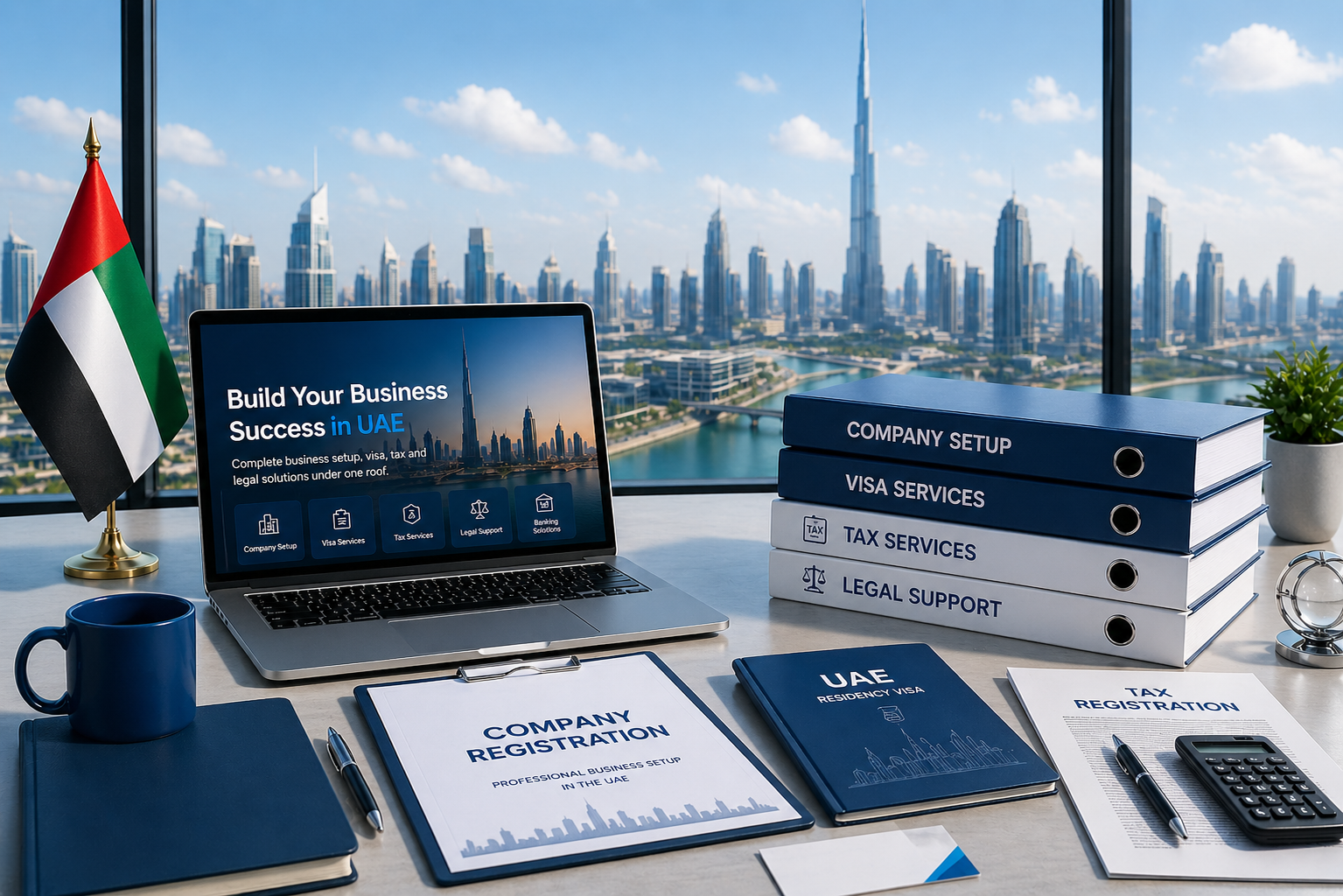
Build Your UAE
End-to-end business setup solutions across Mainland, Free Zone, and offshore jurisdictions in the UAE.
Business
OUR SERVICES
Our Business Setup & Growth Services
Whether you’re starting a new venture or expanding your business, we offer complete solutions to handle setup, legal requirements, and ongoing support in the UAE.
Mainland Companies
Mainland companies are business entities registered under UAE government authorities, allowing companies to trade freely within the UAE and internationally without location restrictions.
Free Zone Companies
Establish your business in the UAE free zones with 100% foreign ownership, tax benefits, and fast licensing support.
Visa Services
Complete UAE visa solutions for individuals, investors, employees, and families with fast processing and professional support.
Additional Services
We provide a full range of additional business support services to help companies operate smoothly in the UAE, from legal documentation and government approvals to…

1+
Years of Experience
ABOUT COMPANY
We help businesses launch, grow, and expand in the UAE
1
+
Businesses Supported
From company formation to visas and legal structuring, we handle everything so you can focus on growing your business.
Why UAE ?
100% foreign ownership
Strong economy
Strategic location
Tax advantages
WHY CHOOSE US
Why Choose Professional Success
18+ Years of Experience
With over 18 years of experience, we have helped businesses of all sizes successfully establish and grow in the UAE.
Save Up to 70% of Time & Cost
We handle the entire process efficiently, saving you time, effort, and unnecessary expenses.
Fast Approvals
Our strong network and expertise ensure quick processing and fast approvals for your business setup.
Full Transparency
We provide clear pricing, timelines, and processes with no hidden fees or surprises.
Free Consultation
Get expert advice tailored to your business needs before you start — completely free.
Continuous Support
Our team stays with you at every step, offering ongoing support even after your business is launched.
Real results backed by years in the UAE market
+18
1
+
Years of Experience
1
%
Time & Cost Savings
1
%
Ownership Support
1
%
HAPPY CLIENTS
OUR WORK PROCESS
How Professional Success Operates
We simplify the entire setup process so you can focus on building your business—not the paperwork.
1
Analysis & Consultation
We start with a free consultation designed to provide unbiased advice on starting your company. We thoroughly analyze the appropriate form of the entity through which a client should conduct business in the UAE to maximize the value of owned assets.
2
Strategic Structuring
We believe that proper structuring is the key to long-term success. When advising on corporate structuring, we consider the client’s business objectives, tax and investment criteria, and potential risk assessments to ensure a deep understanding of their industry.
3
Implementation & Guidance
We guide you through the entire process of establishing your business and arranging your residency. You are notified of all ongoing processes and next steps, ensuring full transparency in terms of costs, schedules, and documentation requirements.
Frequently asked questions
Got Questions? We’ve Got Answers
Find answers to the most common questions about our business setup, visa services, and support solutions in the UAE.
1. What are the different types of business entities available in the UAE?
In the UAE, there are several types of business entities available for entrepreneurs and investors. The main types include:
Mainland Companies
If you want to gain a business advantage within the UAE, or if you prefer not to be located within a free zone, then designate a company in the main location to choose the option that suits you best.
Refers to the areas outside the free zones. Dubai Department of Economy & Tourism (DET) manages registration and licensing of mainland companies. Companies here can operate both within and outside the UAE, including the broader GCC region and in free zones. Since 2020, foreign investors have been able to enjoy 100% ownership in many sectors.
Companies established on the UAE mainland, meaning those based outside a free zone, are free to operate across a wide range of sectors. They can trade with individuals and businesses within and across the UAE, as well as internationally. Most activities now allow 100% foreign ownership, although some may require an Emirati partner, depending on the business type.
A number of business licences are available, depending on how you plan to structure your company and which sector it will operate in. These include:
Industrial licence
Commercial licence
Professional licence
E-trader licence
Dual licence
Free Zone Companies:
Free zones are designated areas that offer various incentives and 100% foreign ownership. These entities cater to specific industries and provide a business-friendly environment with streamlined processes.
It is important to note that companies set up in the free zone cannot trade within the UAE without a specific mainland licence.
A number of business licences are available, depending on how you plan to structure your company and which sector it will operate in. These include:
Industrial licence
Commercial licence
Professional licence
Mainland Companies
If you want to gain a business advantage within the UAE, or if you prefer not to be located within a free zone, then designate a company in the main location to choose the option that suits you best.
Refers to the areas outside the free zones. Dubai Department of Economy & Tourism (DET) manages registration and licensing of mainland companies. Companies here can operate both within and outside the UAE, including the broader GCC region and in free zones. Since 2020, foreign investors have been able to enjoy 100% ownership in many sectors.
Companies established on the UAE mainland, meaning those based outside a free zone, are free to operate across a wide range of sectors. They can trade with individuals and businesses within and across the UAE, as well as internationally. Most activities now allow 100% foreign ownership, although some may require an Emirati partner, depending on the business type.
A number of business licences are available, depending on how you plan to structure your company and which sector it will operate in. These include:
Industrial licence
Commercial licence
Professional licence
E-trader licence
Dual licence
Free Zone Companies:
Free zones are designated areas that offer various incentives and 100% foreign ownership. These entities cater to specific industries and provide a business-friendly environment with streamlined processes.
It is important to note that companies set up in the free zone cannot trade within the UAE without a specific mainland licence.
A number of business licences are available, depending on how you plan to structure your company and which sector it will operate in. These include:
Industrial licence
Commercial licence
Professional licence
2. What are the requirements for obtaining a trade license in the UAE?
The specific requirements for obtaining a trade license in the UAE may vary slightly depending on the emirate and business activity. However, the general requirements include:
1. Business plan: Prepare a detailed business plan outlining your proposed activities, market analysis, financial projections, and other relevant details.
2. Legal structure: Choose the appropriate legal structure for your business, such as an LLC, Sole establishment , Branch of a Foreign Company…etc, based on your activity and requirements.
3. Trade name reservation: Select a unique trade name for your business and get it approved by the relevant authorities. The name should comply with the naming conventions and guidelines provided by the authorities.
4. Premises and tenancy contract: You'll need a physical address for your business. This could be a leased office space or a flexi-desk, depending on your chosen legal structure. A tenancy contract or lease agreement is typically required as proof of your business location.
5. Share capital: Determine the minimum required share capital based on your chosen legal structure and activity. In some cases, the share capital may need to be deposited in a bank account and a certificate of deposit obtained.
6. Approvals and permits: Depending on your business activity, you may need to obtain specific approvals, permits, or licenses from regulatory authorities or industry-specific bodies. This can include health and safety permits, environmental permits, or professional licenses.
7. Application submission: Prepare the required documents and submit your application for a trade license to the relevant licensing authority. These documents typically include application forms, passport copies, visa copies, NOC letters (if applicable), and legal entity documents (such as a Memorandum of Association or Articles of Association).
8. Fees and processing time: Pay the necessary fees for the license application and processing. The time required for the license approval process can vary but typically ranges from a few days to a few weeks, depending on the type of license and the emirate.
1. Business plan: Prepare a detailed business plan outlining your proposed activities, market analysis, financial projections, and other relevant details.
2. Legal structure: Choose the appropriate legal structure for your business, such as an LLC, Sole establishment , Branch of a Foreign Company…etc, based on your activity and requirements.
3. Trade name reservation: Select a unique trade name for your business and get it approved by the relevant authorities. The name should comply with the naming conventions and guidelines provided by the authorities.
4. Premises and tenancy contract: You'll need a physical address for your business. This could be a leased office space or a flexi-desk, depending on your chosen legal structure. A tenancy contract or lease agreement is typically required as proof of your business location.
5. Share capital: Determine the minimum required share capital based on your chosen legal structure and activity. In some cases, the share capital may need to be deposited in a bank account and a certificate of deposit obtained.
6. Approvals and permits: Depending on your business activity, you may need to obtain specific approvals, permits, or licenses from regulatory authorities or industry-specific bodies. This can include health and safety permits, environmental permits, or professional licenses.
7. Application submission: Prepare the required documents and submit your application for a trade license to the relevant licensing authority. These documents typically include application forms, passport copies, visa copies, NOC letters (if applicable), and legal entity documents (such as a Memorandum of Association or Articles of Association).
8. Fees and processing time: Pay the necessary fees for the license application and processing. The time required for the license approval process can vary but typically ranges from a few days to a few weeks, depending on the type of license and the emirate.
3. What are the tax implications for businesses operating in the UAE?
The UAE has a favorable tax environment for businesses, with several key considerations regarding tax implications:
1. Value Added Tax (VAT): The UAE introduced a 5% VAT on the majority of goods and services in January 2018. VAT is applicable to businesses meeting certain turnover thresholds, and they are required to register for VAT, charge VAT on eligible transactions, and file regular VAT returns.
2. The UAE has a favorable tax environment for businesses, with several key considerations regarding tax implications:
⦁ Value Added Tax (VAT): The UAE introduced a 5% VAT on the majority of goods and services in January 2018. VAT is applicable to businesses meeting certain turnover thresholds, and they are required to register for VAT, charge VAT on eligible transactions, and file regular VAT returns.
⦁ Corporate tax (CT), The UAE introduced a 9% Corporate TAX on the all businesses conducting business activities under a commercial license in the UAE.
3. CT Rate
As Per Ministry Of Finance, CT rates are :
⦁ 0 Percent for taxable income up to AED 375,000
⦁ 9 per cent for taxable income above AED 375,000
4. CT will not apply to :
⦁ An individual earning salary and other emploument income, whether received from the public Or the private sectore.
⦁ Interest and other income earned by an indiviual from bank deposits or saving schemes.
⦁ A foreign investor’s income earned from dividends, capital gains,interest , royalties and other inestment
1. Value Added Tax (VAT): The UAE introduced a 5% VAT on the majority of goods and services in January 2018. VAT is applicable to businesses meeting certain turnover thresholds, and they are required to register for VAT, charge VAT on eligible transactions, and file regular VAT returns.
2. The UAE has a favorable tax environment for businesses, with several key considerations regarding tax implications:
⦁ Value Added Tax (VAT): The UAE introduced a 5% VAT on the majority of goods and services in January 2018. VAT is applicable to businesses meeting certain turnover thresholds, and they are required to register for VAT, charge VAT on eligible transactions, and file regular VAT returns.
⦁ Corporate tax (CT), The UAE introduced a 9% Corporate TAX on the all businesses conducting business activities under a commercial license in the UAE.
3. CT Rate
As Per Ministry Of Finance, CT rates are :
⦁ 0 Percent for taxable income up to AED 375,000
⦁ 9 per cent for taxable income above AED 375,000
4. CT will not apply to :
⦁ An individual earning salary and other emploument income, whether received from the public Or the private sectore.
⦁ Interest and other income earned by an indiviual from bank deposits or saving schemes.
⦁ A foreign investor’s income earned from dividends, capital gains,interest , royalties and other inestment
4. Are there any specific industry regulations or licenses required in the UAE?
There are specific industry regulations and licenses required in the UAE, depending on the nature of the business. Some key examples include:
1. Professional Licenses: Professions such as doctors, engineers, accountants, consultants, and artists require specific professional licenses issued by the relevant regulatory authorities.
2. Healthcare: Businesses operating in the healthcare industry, such as hospitals, clinics, pharmacies, and medical equipment suppliers, must comply with the regulations of the UAE Ministry of Health and Prevention (MOHAP).
3. Education: Schools, universities, training centers, and educational institutions must obtain licenses from the relevant educational authorities, such as the Knowledge and Human Development Authority (KHDA) in Dubai.
4. Food and Beverage: Restaurants, cafes, catering services, and food production businesses must comply with regulations from the local authorities, such as the Dubai Municipality's Food Safety Department.
5. Construction and Contracting: Companies involved in construction, engineering, and contracting activities must obtain licenses from the respective emirate's Department of Economic Development, along with compliance with building regulations and permits.
6. Manufacturing: Manufacturing companies need to comply with industry-specific regulations regarding safety, environmental standards, and product certifications.
7. Financial Services: Financial institutions, including banks, insurance companies, and investment firms, must obtain licenses from the relevant regulatory bodies, such as the Central Bank of the UAE or the Insurance Authority.
8. Tourism and Hospitality: Hotels, travel agencies, tour operators, and event management companies must obtain licenses from tourism authorities, such as the Department of Tourism and Commerce Marketing (DTCM) in Dubai.
* These are just a few examples, and requirements can vary depending on the specific industry and emirate in which the business operates.
1. Professional Licenses: Professions such as doctors, engineers, accountants, consultants, and artists require specific professional licenses issued by the relevant regulatory authorities.
2. Healthcare: Businesses operating in the healthcare industry, such as hospitals, clinics, pharmacies, and medical equipment suppliers, must comply with the regulations of the UAE Ministry of Health and Prevention (MOHAP).
3. Education: Schools, universities, training centers, and educational institutions must obtain licenses from the relevant educational authorities, such as the Knowledge and Human Development Authority (KHDA) in Dubai.
4. Food and Beverage: Restaurants, cafes, catering services, and food production businesses must comply with regulations from the local authorities, such as the Dubai Municipality's Food Safety Department.
5. Construction and Contracting: Companies involved in construction, engineering, and contracting activities must obtain licenses from the respective emirate's Department of Economic Development, along with compliance with building regulations and permits.
6. Manufacturing: Manufacturing companies need to comply with industry-specific regulations regarding safety, environmental standards, and product certifications.
7. Financial Services: Financial institutions, including banks, insurance companies, and investment firms, must obtain licenses from the relevant regulatory bodies, such as the Central Bank of the UAE or the Insurance Authority.
8. Tourism and Hospitality: Hotels, travel agencies, tour operators, and event management companies must obtain licenses from tourism authorities, such as the Department of Tourism and Commerce Marketing (DTCM) in Dubai.
* These are just a few examples, and requirements can vary depending on the specific industry and emirate in which the business operates.